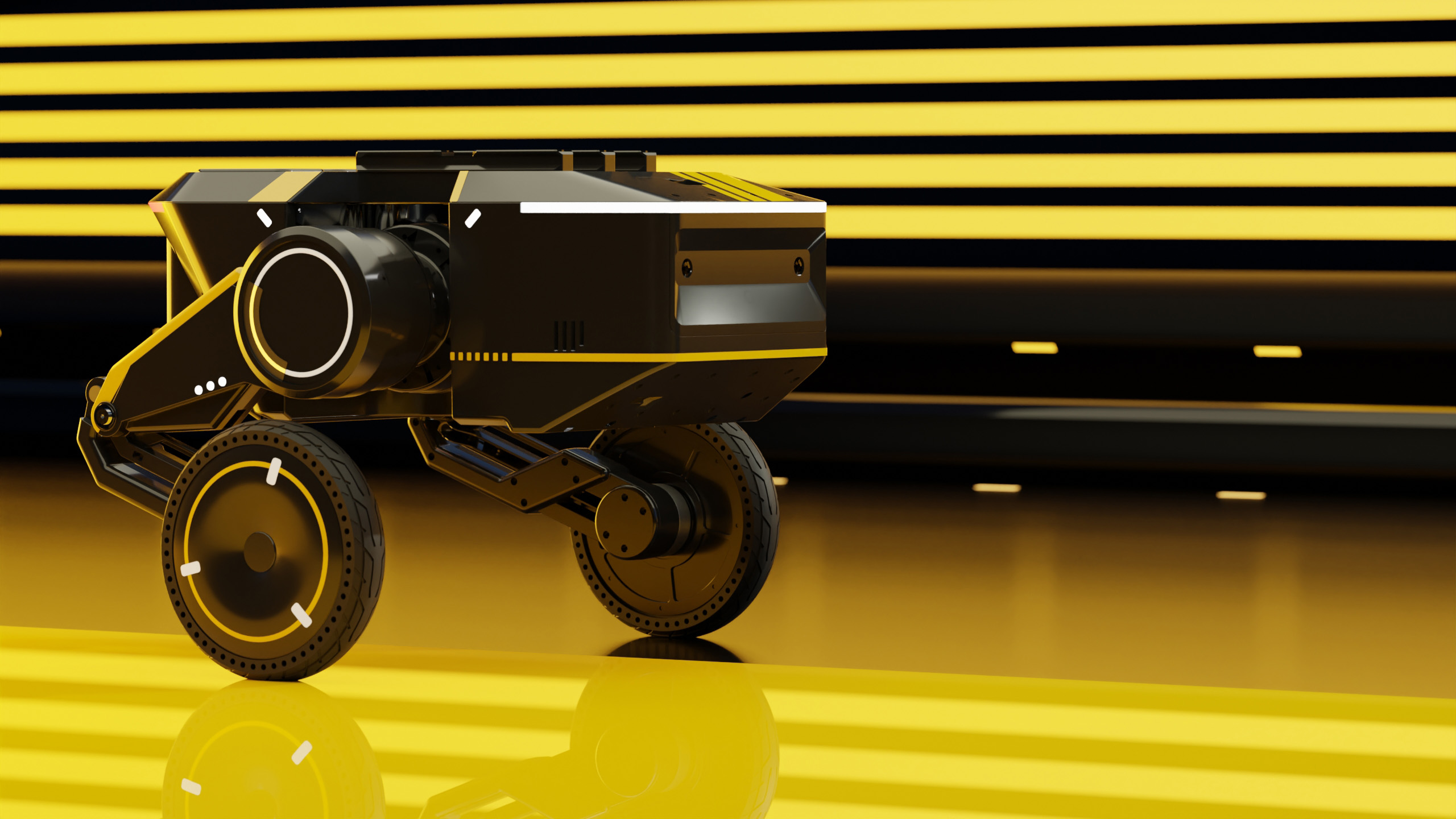
TITA Bridge connects sensors, robotic arms and payload systems through a modular hardware interface designed for robotics development. It supports multi-device communication, real-time data exchange and rapid hardware integration. In robotic research platforms, integration time can be reduced by using standardized interfaces instead of custom connections for each component. The system is suitable for platforms such as an 8DOF wheeled bipedal robot for research, where sensing, motion control and payload operation must work together.
Modern robotic platforms often combine cameras, LiDAR, IMUs, force sensors, robotic manipulators and mission equipment. A research robot may include more than 10 independent hardware modules, each using different communication standards such as CAN, Ethernet, UART or USB. Without a unified integration layer, engineers need to develop separate drivers and communication programs for every device.
TITA Bridge provides a connection method that allows different hardware modules to communicate through a shared architecture. The bridge functions as an intermediate interface between hardware components and robotic control software, reducing the amount of customized development required during system assembly.
A robotic platform with 6–12 connected devices can require weeks of interface testing when each component is integrated separately. A modular bridge approach allows developers to reuse communication structures across different robot configurations.
The development of robotic integration has changed significantly since the early 2010s. Between 2015 and 2025, robotics research moved from fixed industrial automation toward flexible platforms capable of navigation, manipulation and interaction. During this period, the number of sensors installed on advanced mobile robots increased from several basic sensors to integrated perception systems containing cameras, depth sensors, IMUs and environmental monitoring devices.
Sensor integration is one of the main functions supported by TITA Bridge. Different sensors provide different types of information, and the system must organize these data streams before they can be used by robotic applications.
For example, a mobile robot equipped with a stereo camera operating at 30 frames per second, a LiDAR sensor collecting more than 100,000 points per second, and an IMU updating at 200 Hz requires accurate timing coordination. Even a delay of 50–100 milliseconds can affect object recognition and motion control in fast-moving scenarios.
A typical sensor configuration can include:
| Sensor type | Typical output | Common application |
|---|---|---|
| RGB camera | 1920×1080 pixels at 30 fps | Object recognition and visual inspection |
| LiDAR | 100,000–300,000 points/s | Mapping and obstacle detection |
| IMU | 100–1000 Hz measurements | Position and motion estimation |
| Force sensor | 50–500 Hz feedback | Robotic manipulation |
The collected sensor information is transferred through the bridge system and provided to higher-level algorithms. This structure allows developers to replace or upgrade sensors without redesigning the complete robotic platform.
The connection between perception and mechanical movement requires accurate communication between sensors and robotic arms. Robotic arms depend on continuous feedback from encoders, force sensors and external perception devices to achieve accurate positioning.
A six-axis robotic arm may contain six servo motors, six position sensors and multiple control loops. Each motor can require hundreds of feedback updates per second. When a robotic arm performs tasks such as object picking, inspection or assembly, the control system must receive updated information while sending movement commands with low delay.
TITA Bridge supports communication between robotic controllers and external devices, allowing robotic arms to receive information from sensors and adjust their movements according to environmental conditions.
In a vision-guided manipulation system, the camera identifies an object, the software calculates its position, and the robotic arm receives motion commands through the integrated communication structure.
This type of architecture is widely used in research robots, autonomous inspection systems and industrial platforms. The ability to combine perception and manipulation is especially important for robots designed for complex environments.
Payload integration adds another layer of flexibility. A robotic platform may need different tools depending on the application. Inspection missions may require cameras and measurement instruments, while logistics applications may require grippers or transportation modules.
The modular design of TITA Bridge allows payload equipment to be replaced according to mission requirements. Instead of developing a separate robot for every application, engineers can maintain the same base platform and modify the attached equipment.
Common payload examples include:
| Payload type | Function | Example use |
|---|---|---|
| Robotic gripper | Object handling | Laboratory automation |
| High-resolution camera | Visual analysis | Equipment inspection |
| Sampling tool | Material collection | Research missions |
| Communication module | Data transmission | Remote operation |
The same integration concept can be applied to platforms such as an 8DOF wheeled bipedal robot for research, where wheel movement, leg motion, sensing modules and external payloads need coordinated control.
The demand for modular robotic platforms has increased in universities, laboratories and commercial robotics companies. According to robotics industry reports published from 2020 to 2025, research robots increasingly use open communication structures because they reduce development cycles and allow different teams to modify hardware configurations.
For a research platform, the ability to exchange components is important. A robot used for navigation research may require LiDAR and cameras, while a manipulation study may replace these modules with force sensors and robotic arms. The same hardware framework can support different experiments without rebuilding the entire system.
Communication reliability is also important when multiple devices operate together. A robotic system with ten connected devices may generate thousands of data messages every second. TITA Bridge manages communication between these devices so that commands, sensor information and feedback signals can be transferred in an organized manner.
The integration process can be organized into several technical stages:
| Stage | Main task | Typical output |
|---|---|---|
| Hardware connection | Install sensors, arms and payloads | Physical integration |
| Interface configuration | Define communication settings | Device recognition |
| Data testing | Verify transmission speed and accuracy | Stable communication |
| Application development | Connect control software | Functional robot operation |
This approach reduces repeated engineering work when developing different robot versions. A platform developed in 2024 can continue using the same integration framework when upgraded with new sensors or payload equipment in later years.
Robotic systems are also becoming more specialized. A warehouse robot, inspection robot and research robot may have completely different tasks, but they share similar requirements: reliable sensing, accurate movement and flexible equipment connections.
TITA Bridge provides an architecture that allows these different systems to use similar integration methods. By combining sensors, robotic arms and payload modules within one communication framework, developers can create robotic platforms that are easier to modify and maintain.
Future robotic applications will continue to require flexible hardware combinations. As robots move from controlled factory environments into laboratories, outdoor areas and service scenarios, the ability to connect different components efficiently will remain an important part of robotic system development.