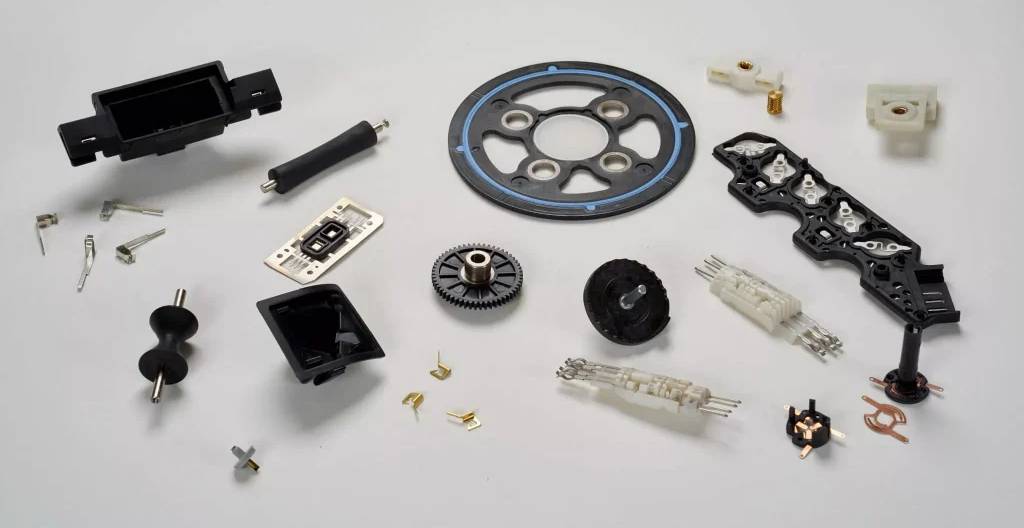
Professional injection molding suppliers serve industries that need repeatable dimensions, controlled material performance, high production volumes, and stable part quality. Automotive programs may require 100,000 to more than 1 million parts per year, while medical and electronics projects often work with tolerances near ±0.05 mm on small features. Packaging molds may contain 16, 32, or 64 cavities to reduce unit cost, and hardened production tooling can exceed 500,000 molding cycles when maintained correctly. Automotive, medical, electronics, packaging, industrial equipment, aerospace, energy, telecommunications, and consumer-product manufacturers benefit most because part failure, dimensional variation, or poor tooling can affect entire assemblies.
Injection molding becomes more useful as annual volume rises because tooling cost is distributed across more units. A $60,000 production mold used for 10,000 parts adds $6.00 of tooling cost per part before resin, labor, inspection, or shipping; at 500,000 parts, the same mold contributes only $0.12 per part. A supplier that can balance cavity count, cycle time, mold steel, cooling design, and expected annual volume can prevent a company from paying for tooling capacity it will never use.
Automotive manufacturing shows the scale clearly. A vehicle can contain hundreds of molded polymer components, including electrical connectors, HVAC parts, clips, console structures, sensor housings, lighting components, under-hood covers, brackets, buttons, and interior trim. Polypropylene, ABS, polyamide, PBT, polycarbonate, and glass-filled engineering plastics are widely used because one vehicle requires materials with very different heat, impact, chemical, and surface requirements.
Weight reduction also affects material choice. Replacing a metal bracket with a well-designed glass-filled polymer part can reduce the component weight by 30% to 60% in suitable applications, while eliminating machining or corrosion-protection steps. The molded replacement still has to account for creep, thermal expansion, fiber orientation, screw retention, and long-term temperature exposure, so material substitution normally needs more engineering work than simply copying the geometry of a metal part.
A molded automotive connector may look simple, but terminal position, latch geometry, sealing surfaces, wall thickness, and shrinkage must remain consistent after hundreds of thousands of cycles.
Medical manufacturing places more emphasis on traceability and controlled processing. Disposable diagnostic parts may be produced in batches of 100,000 units or more, while reusable device housings may be made in much smaller annual quantities. Dimensional requirements can still be tight because molded parts often connect with tubing, electronics, seals, needles, filters, or other components where a small dimensional error affects assembly.
Medical-grade polypropylene, polycarbonate, polyethylene, TPE, and other polymers may be selected according to chemical exposure, transparency, flexibility, sterilization method, or intended contact conditions. A polymer suitable for one product may perform poorly after repeated steam, radiation, or chemical sterilization, so resin selection has to follow the actual use environment rather than the generic material name.
FDA-regulated manufacturing also increases the importance of documentation. A supplier may need lot traceability, resin records, controlled process parameters, dimensional inspection records, change management, and documented equipment maintenance. ISO 13485, first published in 1996 and revised several times since, is widely used by medical-device organizations as a quality-management framework. The molding supplier may not design the finished medical device, but its production records can still become part of the manufacturer's compliance work.
Electronics manufacturing has a different geometry problem: parts keep getting smaller while functional features remain numerous. Connector housings, switch bodies, sensor enclosures, battery components, plug structures, cable parts, internal frames, and insulating parts may use walls close to 0.8-1.5 mm, small ribs, narrow slots, snap features, or precisely located metal contacts.
Insert molding can reduce assembly work by placing terminals, threaded inserts, bushings, or stamped metal components into the mold before resin injection. One molding cycle can replace two or three later assembly steps, although the process requires controlled insert placement and reliable retention during filling. A 16-cavity tool with unstable insert positioning can create 16 defective parts in one cycle, so fixture accuracy and automated detection become more important as cavity count increases.
Consumer products add appearance requirements to the same dimensional concerns. A power-tool housing, kitchen appliance enclosure, personal-care device, storage product, or control knob may need textured surfaces, color consistency, clean parting lines, reliable screw bosses, snap fits, and enough stiffness to survive repeated handling. A visible sink mark of only a few tenths of a millimeter can be unacceptable on a high-gloss surface even when the component remains mechanically usable.
Surface quality begins with geometry. Thick sections cool more slowly than surrounding walls and can produce sink or internal voids; ribs and bosses therefore need dimensions that support both strength and even cooling. Many designers use rib thickness near 40% to 60% of the adjoining wall thickness as an initial design range, then adjust it according to polymer, mold flow, stiffness, and surface requirements.
Packaging manufacturers operate under stronger pressure on cycle time and resin usage because volumes can reach millions or tens of millions of units per year. Caps, closures, dispensing parts, cosmetic packages, reusable containers, and pharmaceutical packaging components are often produced with high-cavity tooling.
| Production factor | Typical manufacturing effect |
|---|---|
| 16-64 mold cavities | More parts produced per machine cycle |
| 8-25 second cycle time | Common target range for many small high-volume parts |
| 1 g material reduction | Saves 1 metric ton of resin per 1 million parts |
| 2% scrap reduction | Removes 20,000 rejected parts from a 1 million-part run |
| Automated handling | Reduces manual contact and keeps cycle timing more consistent |
The material calculation is easy to overlook. Reducing one part from 18 g to 17 g saves 5.6% of its resin weight. At 10 million units, that one-gram reduction removes 10 metric tons of polymer from annual material consumption. The lighter design still has to pass torque, drop, sealing, stacking, or transport requirements, which is why wall reduction is normally checked through simulation, prototype testing, and production sampling before release.
Industrial machinery moves the discussion away from appearance and toward long service life. Molded components are used for control housings, electrical covers, guides, knobs, cable parts, protective guards, rollers, handles, machine interfaces, and internal brackets. Some operate around oils, cleaning chemicals, outdoor moisture, dust, vibration, or elevated temperatures for 5, 10, or more years.
Material selection in those conditions may involve PA66, POM, PBT, PC, PPS, reinforced polypropylene, or other engineering polymers rather than general-purpose resins. Glass fiber contents of 20% to 40% are common in many reinforced grades, improving stiffness but also changing shrinkage and creating directional properties. A dimension measured across fiber orientation may behave differently from the same dimension measured along the flow direction.
That is one reason companies buying Industrial injection molding solutions often need supplier involvement before the mold is cut. Gate position, flow direction, cooling layout, draft, venting, ribs, bosses, shutoffs, inserts, and expected shrinkage all affect whether the finished component fits the assembly after molding.
Aerospace and transportation programs usually operate at lower volumes than packaging, but material documentation and repeatability can be stricter. Interior panels, clips, ventilation parts, electrical housings, connector components, seat-related parts, covers, and brackets may require flame, smoke, mechanical, or temperature performance defined by the application.
Lower production volume changes the tooling calculation. A program expecting 25,000 parts over its life may not need the same mold steel, automation level, or cavity count as a program expecting 2 million parts each year. An eight-cavity tool can raise upfront cost without providing a practical benefit when annual demand can already be met with one or two cavities and reasonable machine utilization.
Energy equipment creates another mixture of electrical and outdoor requirements. Battery systems, charging equipment, solar hardware, electrical cabinets, connectors, cable-management parts, sensor housings, and protective enclosures may remain outdoors for 10 years or longer. UV exposure, moisture, temperature cycles, flame requirements, and electrical insulation can narrow the list of suitable polymers.
Telecommunications hardware has similar demands but often adds precise interfaces with circuit boards, connectors, fiber components, ports, and mounting hardware. A dimensional shift of 0.1 mm can matter when several molded and metal components stack together inside a compact enclosure. Suppliers therefore control not only cavity dimensions but also moisture conditioning, cooling time, mold temperature, holding pressure, and post-molding inspection.
Across all of these industries, machine size alone says little about production capability. A 500-ton molding press can make large parts, but it does not show whether a supplier can repeatedly hold a ±0.05 mm connector dimension, mold a 0.9 mm wall without short shots, manage 30% glass-filled resin, or maintain a 32-cavity tool over 1 million cycles.
Mold construction also changes the economics over time. Aluminum tooling may be suitable for prototypes and some lower-volume programs, while hardened steels are normally chosen when wear, pressure, abrasive fillers, or long production life require greater durability. A mold expected to make 5,000 parts has a different design target from one expected to make 1 million parts.
Production data should continue after mold approval. Cavity pressure, melt temperature, fill time, cooling time, part weight, dimensional checks, machine alarms, and scrap records can show process changes before rejected parts become a large batch. If a 500,000-part order has a 3% reject rate, 15,000 parts require replacement, sorting, or disposal; reducing rejection to 1% removes 10,000 defective units from the same order.
Supplier selection therefore works best when purchasing teams compare more than quoted piece price. They can review material-processing experience, mold design capability, press range, inspection equipment, maintenance procedures, traceability, sample approval methods, secondary operations, and realistic annual capacity. For a program running 250,000 parts each year for six years, tooling life and process stability usually matter more than saving a few cents on the first short production run.
The strongest fit is usually found in industries where volume, dimensional control, material performance, tooling investment, and assembly requirements overlap. Automotive, medical, electronics, packaging, industrial equipment, aerospace, energy, telecommunications, and consumer-product manufacturers all operate under different rules, but each can lose substantial time and money when a molded component changes size, breaks early, arrives inconsistently, or cannot be produced at the required rate.